Custom Perfume for E-Commerce: The Compliance Documents You Need Before Launch
An e-commerce perfume launch lives or dies on its document file, not its bottle. Before the first order ships, a custom perfume needs a safety assessment, a dossier that holds it, market-specific labelling, and the manufacturer's batch and IFRA records. The brands that launch on time assemble this file in a deliberate order — formulation data first, market shells second — instead of discovering which document is missing when the courier refuses the shipment.
Key takeaways
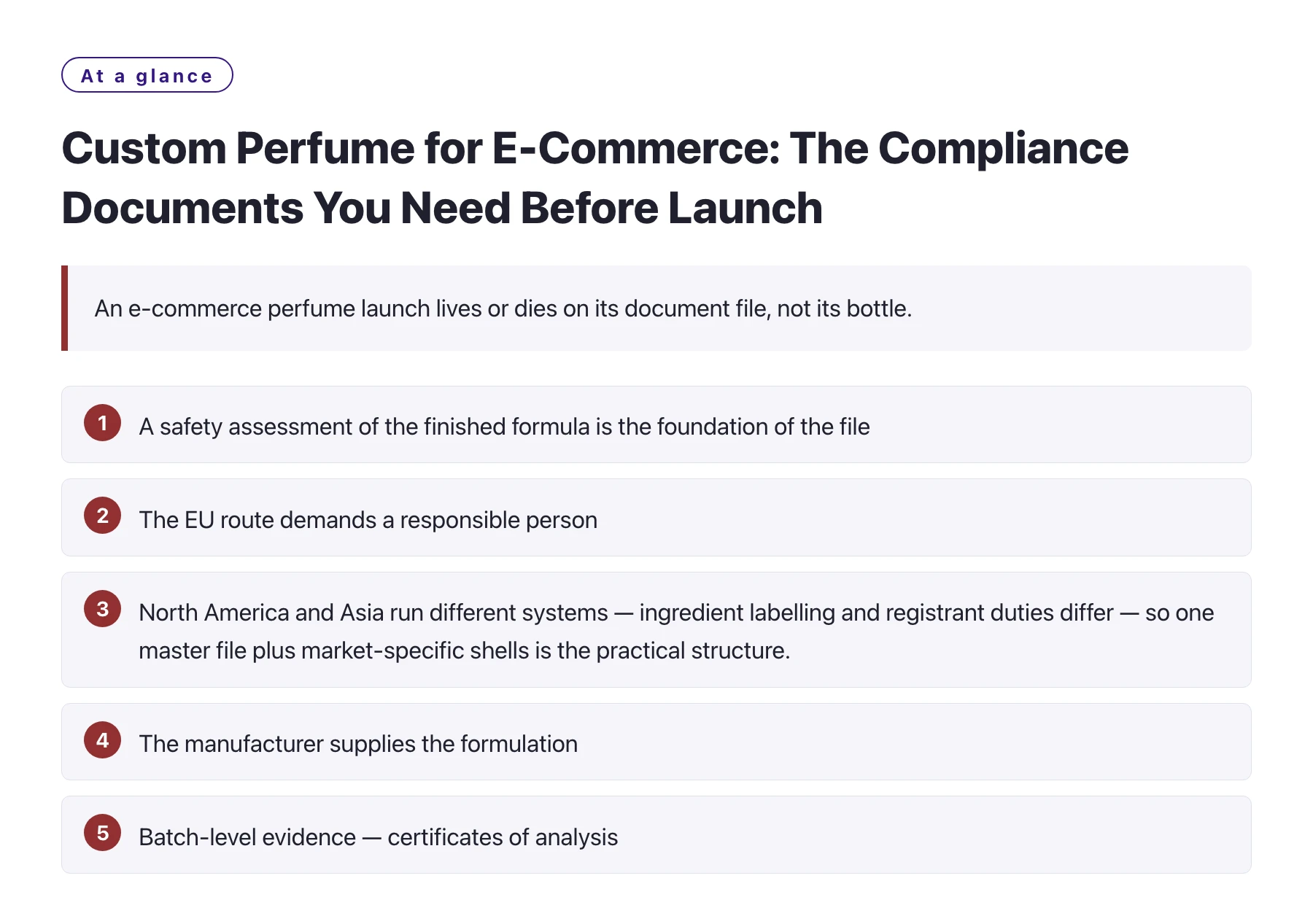
- A safety assessment of the finished formula is the foundation of the file, and it has to exist before labelling, filling or shipping decisions are made.
- The EU route demands a responsible person, a product information file and notification before market placement, regardless of how small the online shop is.
- North America and Asia run different systems — ingredient labelling and registrant duties differ — so one master file plus market-specific shells is the practical structure.
- The manufacturer supplies the formulation, stability and IFRA data; the brand holds the responsibility for the final market documents, and the split should be written into the agreement.
- Batch-level evidence — certificates of analysis, stability and microbiology reports — is what a marketplace or an importer will actually ask for first.
Marketplaces and freight forwarders have made perfume e-commerce dramatically easier to start, but they have not changed the underlying rule: a perfume is a cosmetic product, and cosmetics are regulated in every market of any size. The difference between sellers who launch smoothly and sellers who stall is rarely the scent. It is whether the document file was built in the right order.
This article goes through the core of that file, the market differences that matter most to an online brand, and the sequence that keeps the launch date intact.
The documents an e-commerce brand actually needs
The file starts with the formula. Working with a manufacturer that positions itself as a Xuelei custom perfume manufacturer gives you a partner who holds the formulation record, the raw material data and the stability work that everything else in the file is built on.
From the formula data, three documents follow in most markets: a safety assessment of the finished product, a product information dossier that holds it, and the label text with the correct ingredient and allergen declarations. IFRA compliance for the fragrance itself is a fourth layer — the industry's own safe-use standards are applied at the formulation stage, and a supplier you can trust will state that plainly [1]. A house that publishes its certifications on its own site, as Xuelei does, shortens the verification step considerably.
The European route
In the European Union, the framework is harmonised: a responsible person must be established in the EU, the product must have a safety assessment by a qualified assessor, a product information file must be kept available, and the product must be notified before it is placed on the market — the Commission's cosmetics pages describe exactly these obligations [2]. Allergens above set thresholds must be listed on the label, which is why the allergen declaration is part of the label text, not an optional extra.
The North American route
Canada does not run a pre-market approval system for cosmetics, but the product must still be safe for its intended use, properly labelled with an ingredient list, and the manufacturer or importer carries the record-keeping responsibility [3]. The United States works on a similar safety-responsibility model, which means the brand's own due diligence file matters more, because no government agency is pre-approving the product.
The rest of the map
Asian markets run their own registration or filing systems — China, for example, requires imported ordinary cosmetics such as perfume to be filed before sale. When production happens under contract perfume manufacturing in China, the exporter's own file — commercial invoice, packing list and any movement certificates — becomes part of your paperwork too contract perfume manufacturing in China. The practical rule is simple: ask the forwarder or importer for the document list before you book the first container, never after.
Who holds which document
| Document | Who creates it | Why the brand needs it |
|---|---|---|
| Formulation and raw material data | Manufacturer | The technical base of the whole file |
| Safety assessment of the finished formula | Qualified assessor | Required before sale in the EU and expected in most other markets |
| Stability and microbiology reports | Manufacturer or third-party lab | Evidence the product travels and stores well |
| IFRA compliance statement | Manufacturer | Shows the fragrance meets safe-use standards |
| Product information file | Brand or consultant | The archive that holds the assessment and records |
| Labelling and notifications per market | Brand with the market's rules | What the marketplace and the importer actually check |
Notice what is missing from this table: marketing claims. A claim such as 'cruelty-free' or 'natural' is itself substantiation work in several markets, so treat the claim list as a document, not a slogan.
Build the file in the right order
- Freeze the formula data firstAsk the manufacturer for the full formulation record, raw material sources and any preservative or allergen declarations before you design the label. Labels change when the data changes.
- Commission the safety assessmentSend the frozen formula to a qualified assessor and get the assessment written against the real product, not a generic template. This is the document that makes other documents possible.
- Add third-party batch evidenceIndependent testing of stability and microbiology on the actual production batches closes the loop that a marketplace or importer will probe first — laboratories such as SGS run exactly these tests for cosmetics dossiers [4].
- Write the market shellsBuild one master file, then produce the EU notification, the Canadian labelling shell and any filing documents each market needs. Marketplaces rarely accept a foreign shell.
- Keep the batch file aliveEvery production run should update the file with its certificate of analysis. A launch file is a dossier you maintain, not a one-time package.
The single most expensive mistake in e-commerce perfume is ordering the bottle before the formula data is frozen. A beautiful label reworked once costs time; a safety assessment re-run because the formula changed costs weeks and a new round of stability testing. Data first, design second, launch third.
Sources
- IFRA: Safe Use and Fragrance Science —— IFRA's explanation of how fragrance materials are scientifically assessed for safe use and how those conclusions are applied by the industry.
- European Commission: Cosmetic Products — Specific Topics —— EU pages covering specific cosmetics topics such as product claims, nanomaterials and animal-testing rules.
- Health Canada: Cosmetic Safety —— Health Canada's cosmetics pages, covering cosmetic notification, the ingredient hotlist and safety requirements for cosmetics sold in Canada.
- SGS: Cosmetics, Personal Care & Household Testing —— Testing, inspection and certification services for cosmetics and personal care, including microbiological, stability and safety testing aligned with cosmetics GMP.
Frequently asked questions
Do I need a safety assessment for a small e-commerce perfume launch?
In markets with a cosmetics regulation — the EU being the clearest example — yes, the product needs a safety assessment by a qualified assessor and a responsible person before it can be sold, regardless of order size.
What is the difference between a safety assessment and a product information file?
The safety assessment is the scientific evaluation of the finished formula. The product information file is the complete dossier that holds that assessment alongside manufacturing records, labels and test reports — think of one as the report and the other as the archive.
Does selling on a marketplace change the compliance requirements?
No. Marketplaces may add their own document checks, but the cosmetics rules apply to the product wherever it is sold. Compliant labelling and a complete file prevent most marketplace suspensions before they start.
Who prepares the documents — me or the manufacturer?
The responsible person in the destination market is accountable, but the manufacturer typically supplies the formulation, safety and stability data the assessment depends on. Write the split explicitly into the agreement.
Can one document pack cover several markets?
Partially. EU and Canada can share a common safety assessment more easily, but allergen lists, labelling languages and filing systems differ. Build one master file, then market-specific shells around it.