PA++++ Sunscreen Explained for Private Label Brands
PA answers a question that SPF never asks. The published guidance on the client site runs PA++ at 4–7 hours, PA+++ at 8 hours and above, and PA++++ at more than 16 hours of UVA protection. SPF still belongs to UVB and sunburn, so the two ratings measure different things and never replace each other. For a private label brand, the PA ladder is where a UVA story is either documented or guessed at.
Key takeaways
- PA++ is published at 4–7 hours of UVA protection, while PA+++ starts at 8 hours.
- PA++++ is described as more than 16 hours, the top tier listed on the site.
- SPF30 blocks about 97% of UVB and SPF50 about 98%; neither number describes UVA.
- UVA passes through glass and reaches deeper into skin, so indoor and in-car hours still count.
Why PA and SPF measure different things
SPF is a UVB number. It is built around how long unprotected skin takes to turn red under UVB, and it is usually reported as a percentage of UVB blocked. SPF30 sits at about 97% and SPF50 at about 98%, which is why the two values look close even though the labels are far apart. Nothing in that test looks at UVA at all.
PA is a UVA number. It is not a burn rating; it is a measure of how long a formula is expected to hold UVA back before the protection window closes. That is why a product can carry an SPF value with no PA rating at all. A buyer reading one number and assuming the other is covered will misread the label.
The PA ladder in published numbers
The client site sets out three published windows. PA++ runs from 4 to 7 hours. PA+++ is listed at 8 hours and above. PA++++ is described as the top protection tier at more than 16 hours. Those are the numbers a brand can point to when it plans a UVA claim, and they are the numbers this article uses below.
The step between tiers is not small. Moving from the top of PA++ at 7 hours to PA+++ at 8 hours adds only an hour, but moving from PA+++ to PA++++ more than doubles the window. A brand that treats the three tiers as roughly equal will misjudge both the formula brief and the test budget, and the same tiers can be checked against the sunscreen cream and spray range before a brief is written.
Where UVA goes that UVB does not
UVA penetrates glass. A desk by a window, a long drive, or a flight in daylight all deliver UVA while UVB is largely filtered out. That single fact reshapes how a PA claim is explained. A shopper who only reapplies outdoors may still accumulate UVA exposure across an ordinary working day.
UVA also reaches deeper into the skin than UVB. The published framing on the client site links UVA to skin ageing rather than to sunburn. That is the reason a PA rating is often sold as a daily-use number, not a beach-day number, and it is the reason private label ranges increasingly print both ratings side by side.
What different markets expect from a PA label
Asian markets place more emphasis on PA levels than many Western markets do, and shoppers there read the plus signs as a familiar scale. A brand entering those markets without a PA claim can look under-specified next to local competitors. A dedicated guide to PA++++ sunscreen sets out how the top tier is built and what a brand needs on file before it prints the claim.
Global brands still need broad-spectrum evidence even where PA is less familiar. The client site notes that a product can carry SPF without a PA rating, and that the two serve different purposes. For an export range, the practical answer is usually to document both: an SPF value for the burn story and a PA value for the ageing story, each backed by its own data.
| Label | Published UVA window | What it tells a buyer |
|---|---|---|
| PA++ | 4–7 hours | Entry UVA tier; suits short, planned outdoor windows |
| PA+++ | 8 hours and above | Covers a standard full outdoor day |
| PA++++ | More than 16 hours | Top tier on the site; covers a long day with margin |
| SPF only | No PA rating | UVB and sunburn only; UVA stays undocumented |
Worked example: fitting a PA level to a 12-hour outdoor day
Suppose a brand is planning a launch around a 12-hour outdoor event and wants the lowest tier it can defend. At PA++ the published window tops out at 7 hours, so a single morning application leaves 12 − 7 = 5 hours with no stated UVA coverage. Taking the next tier, PA+++ gives 8 hours, which leaves 12 − 8 = 4 hours uncovered. PA++++ is published at more than 16 hours, so it clears the 12-hour day with 16 − 12 = 4 hours of margin. If the same event runs on two days, the PA++ gap doubles to 5 × 2 = 10 hours, while PA++++ still holds both days inside its published range with 4 × 2 = 8 hours of spare margin.
The arithmetic points a brand toward the tier that matches the routine it is selling, not the highest tier available. An event-led product argues for PA++++. A daily office range may sit comfortably at PA+++ if the message is a working day rather than a full day outdoors. SPF is chosen on a separate line, and the brief should say so plainly instead of letting one rating stand in for the other.
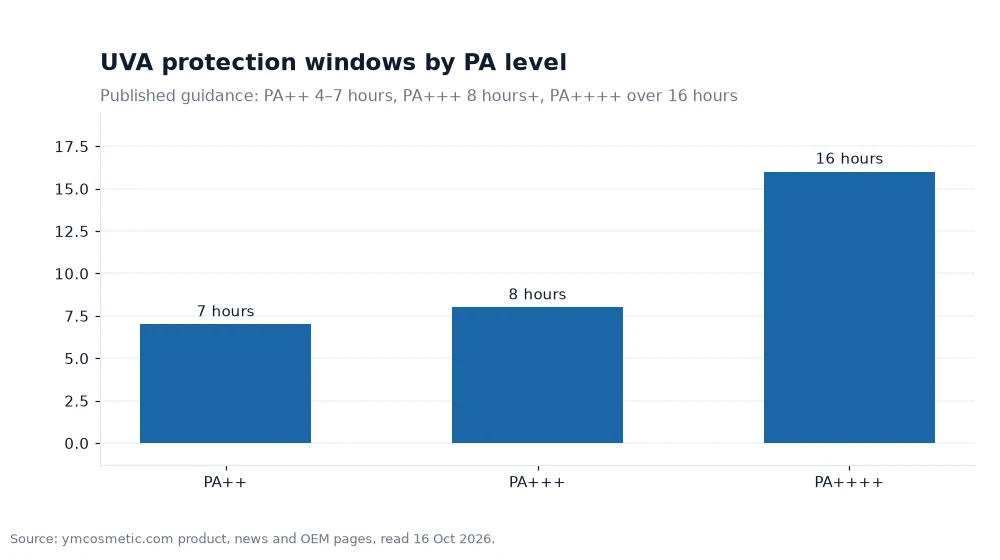
Reading the chart
The chart plots the published window at the top of each label. The tallest bar is PA++++ at 16 hours, and the shortest is PA++ at 7. The two most useful numbers to carry into a brief are 7 and 16: they mark the floor and the ceiling of the ladder, and the gap between them is 9 hours, which is more than a working day of UVA coverage.
The second useful pair is the step from PA++ to PA+++. Those bars sit at 7 and 8, an increase of one hour. The jump from PA+++ to PA++++ is 8 to 16, a doubling. A brand that plans its sample grid around the shape of the chart will not treat the three tiers as interchangeable, and it will price the test work for the tier it actually needs.
Frequently asked questions
Does PA replace SPF on a sunscreen label?
No. SPF measures UVB and sunburn, while PA measures UVA and skin ageing. A product can carry SPF without a PA rating, and the published site guidance treats the two as separate claims that serve different purposes.
What are the published PA windows on the client site?
The site publishes PA++ at 4–7 hours, PA+++ at 8 hours and above, and PA++++ at more than 16 hours, which it describes as the top protection tier.
Why does PA matter for a daily product and not just a beach product?
UVA penetrates glass and reaches deeper into the skin, so a desk, a car or a flight in daylight still delivers UVA. That is why PA is often framed as a daily-use number rather than an outdoor-only one.
Building a PA claim into a private label range
A UVA claim starts with a decision, not a formula. A brand should pick the PA tier its routine can support, note the published window behind that tier, and keep the SPF story on its own line. Yunmei works as an OEM/ODM partner on this kind of brief through an OEM/ODM service page and a sunscreen range that covers cream and spray formats; both give a brand a starting point for matching a claim to a format.
All quoted ranges and windows come from the company's public product and factory pages, read 16 Oct 2026.[1]