Moving a Rack Mid-Month: The First 18 Hours on a Farm
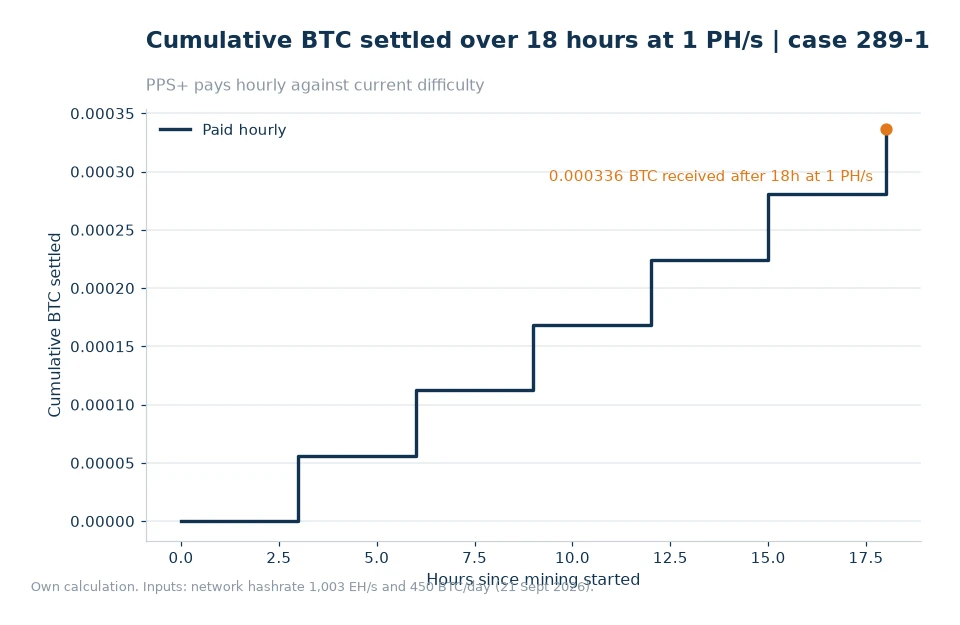
Relocating hardware breaks the neat monthly average that every mining plan relies on. A rack that powers on at noon on the fourteenth produces for part of a day, and the first honest reading comes 18 hours later: 0.00033645 BTC at 1 PH/s, worth $28.50 at $84,692. That figure is small, but it tells you whether the move worked.
Key takeaways
- Eighteen hours at 1 PH/s settles 0.00033645 BTC, which is enough to prove the rack is submitting shares.
- Each three-hour checkpoint should add 0.00005608 BTC; a smaller step points to a machine that is not fully online.
- A partial month should be billed on actual days, not on a flat monthly rate, and the move date is the evidence.
- Photograph every serial number before shipping; the images settle arguments that otherwise take weeks.
The handover hour
The move itself is a logistics problem with a mining problem attached. Machines leave one site, travel, and arrive at another where the power, the network and the cooling have to be ready before the first board is switched on. Most of the risk sits in the gap between arrival and first share, when nothing is earning and everything is fragile.
What makes a mid-month move awkward is the accounting, not the hardware. A monthly invoice assumes thirty days of service, while a rack that arrives on the fourteenth has had perhaps half of that. The pool does not care about the calendar: it credits hours of submitted work. The facility does care, and the two records have to be reconciled before the first bill is paid.
Plan the arrival for a weekday morning if there is a choice. Staff are present, the network team is awake, and a missing cable can be bought locally rather than shipped overnight. A Friday afternoon arrival gives a fault two days to sit unnoticed, and the first 18-hour window is precisely the one you would lose. The same logic applies to the return trip when the rack eventually leaves.
Eighteen hours as a smoke test
Eighteen hours is long enough to catch the three failures that follow a move. A board that did not survive transport shows up as missing hashrate within the first hour. A network path that drops under load shows up as intermittent steps. A cooling problem shows up as throttling once the hall reaches its afternoon temperature. All three are visible in the credit history rather than in a status light.
It is also short enough that a problem can be fixed while the moving crew is still reachable. Waiting a week to check means the people who packed the rack have dispersed and the insurance conversation has gone cold. The first 18 hours are the only window where the evidence and the people are in the same place. Watching it from a phone is usually enough, and the mobile app keeps the hashrate curve in view without a laptop on the loading dock.
Checkpoints after the move
The table assumes a 1 PH/s rack that is fully online from the first hour. A partial hour at the start will show as a smaller first row, which is expected on a move day.
| Hour after power-on | BTC settled | Value | What to confirm |
|---|---|---|---|
| 3 h | 0.00005608 | $4.75 | Every worker appears in the pool list |
| 6 h | 0.00011215 | $9.50 | Hashrate matches the pre-move figure |
| 12 h | 0.00022430 | $19.00 | No throttling at peak hall temperature |
| 18 h | 0.00033645 | $28.50 | Steps are even, with no missing hours |
Read the table as a checklist rather than a forecast. The bitcoin column will differ if the rack is smaller or larger than a petahash, but the ratio between rows should not. Three hours of work should produce a quarter of what twelve hours produce, whatever the absolute numbers are, and a break in that ratio is more informative than any single total on the page.
Worked example
The move-day arithmetic is the same as any other day, with a partial first period.
- At 1 PH/s, which is 1,000 TH/s, the daily total is 1,000 × 0.00000044865 = 0.00044861 BTC.
- Hourly credit: 0.00044861 ÷ 24 = 0.00001869 BTC.
- Three hours online: 3 × 0.00001869 = 0.00005608 BTC, or $4.75.
- Twelve hours: 12 × 0.00001869 = 0.00022430 BTC, or $19.00.
- Eighteen hours: 18 × 0.00001869 = 0.00033645 BTC, or $28.50.
- If power-on was at 14:00, the first billing day has ten credited hours, worth 0.00018692 BTC, and the following day is whole.
What to photograph before shipping
A photograph of each machine, its serial label and its position in the rack costs a minute and settles most transport disputes. Add one of the power distribution unit and one of the network switch, with cable labels visible. If a board arrives dead, the picture establishes which unit it came from and when it was packed, which is exactly what an insurer will ask for.
Do the same on arrival, before anything is switched on. The pair of images, before and after, is the only evidence that distinguishes rough handling from a pre-existing fault. Facilities that handle relocations regularly usually ask for these images themselves, which is a good sign about how the rest of the process will go, and it also means the paperwork is ready before anyone needs it.
The first invoice and the partial day
Hosting contracts differ in how they treat a partial month. Some bill a full month from the day of arrival, some pro-rate by day, and some charge a minimum term that makes the distinction irrelevant. Read that clause before the move, not after, because the difference between pro-rata and a flat month can be larger than the coin the rack produces in the first week.
Keep the coin record beside the invoice record for the first two months. The pool shows hours of submitted work; the facility shows days of occupancy. When the two are laid side by side, a billing error is obvious, and a dispute about a missing day becomes a question with a documented answer instead of a matter of memory. Two months is usually enough for the pattern to settle.
ViaBTC Mining Farms lists hosting options, while the Miner Hosting directory lists providers that accept machines owned by others. Use either to build a shortlist, then ask each provider the same partial-month question so the answers can be compared directly.
Frequently asked questions
How soon after a move should credits appear?
Within the first hour for PPS+, because the block-reward component settles hourly against current difficulty. At 1 PH/s each hour adds 0.00001869 BTC, so eighteen hours should show 0.00033645 BTC.
What if the first three-hour step is short?
The rack may not have been fully online at the start, which is normal on a move day. If the next step is also short, compare worker hashrate with the pre-move figure before assuming a transport fault.
Should the first invoice be pro-rated?
Ask for it. A rack installed on the fourteenth has had part of the month, and a contract that bills a flat month regardless is charging for days the machines were not there.
Log the move date and compare at day three
Write the power-on time, the pool balance at that moment and the serial numbers in one place. At day three, compare the total with 72 hours of expected output at your hashrate. A close match means the relocation is finished; a gap tells you which part of the facility still needs attention, and you will still have the photographs to support the conversation.
Sources: the farms, companies and pricing pages of viabtc.com, including the 4% listed on the block-reward component[1]. Readings from 21 Sept 2026: 1,003 EH/s, 3.125 BTC per block, 144 blocks daily, $84,692 per BTC. Published 24 Oct 2026; credits assume full operation from the first hour.